
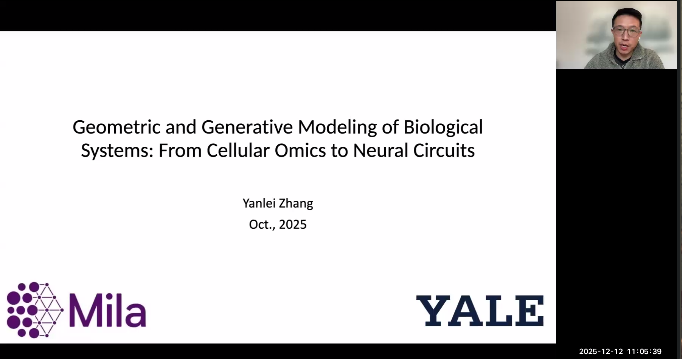
Understanding cellular states and their transitions from high-dimensional gene expression data remains a central challenge in computational biology. In this talk, I will present a machine learning framework grounded in differential geometry that learns meaningful, low-dimensional representations of cell populations. By modeling single-cell RNA sequencing data as points on a neural manifold, our approach preserves both local and global geometric structure, enabling biologically faithful visualization and analysis. We introduce a neural network architecture that constructs a differentiable manifold of cell states and derives an associated information metric to quantify relationships between them. Using neural ordinary differential equations and conditional flow matching, we perform geodesic interpolation across this manifold to capture differentiation trajectories. Applied to the Embryoid Body stem cell dataset, our method accurately reconstructs developmental pathways, identifies progenitor populations, and predicts unseen cell states with state-of-the-art performance. If time permits, I will also discuss extensions of this geometry-preserving framework to time-series neural data–such as electrophysiology, fMRI, and calcium imaging–where it enables interpretable representations that improve performance in tasks including stimulus decoding and clinical classification.
Bio
Yanlei Zhang is a postdoctoral researcher at Mila. His research interests span the areas of geometric analysis, functional analysis, geometric control theory, partial differential equations and sheaf theory. In his current research, the combination of geometry, function analysis, algebra and in particular, sheaf theory has given wider perspectives and approaches of understanding certain questions from a more elevated perspective.