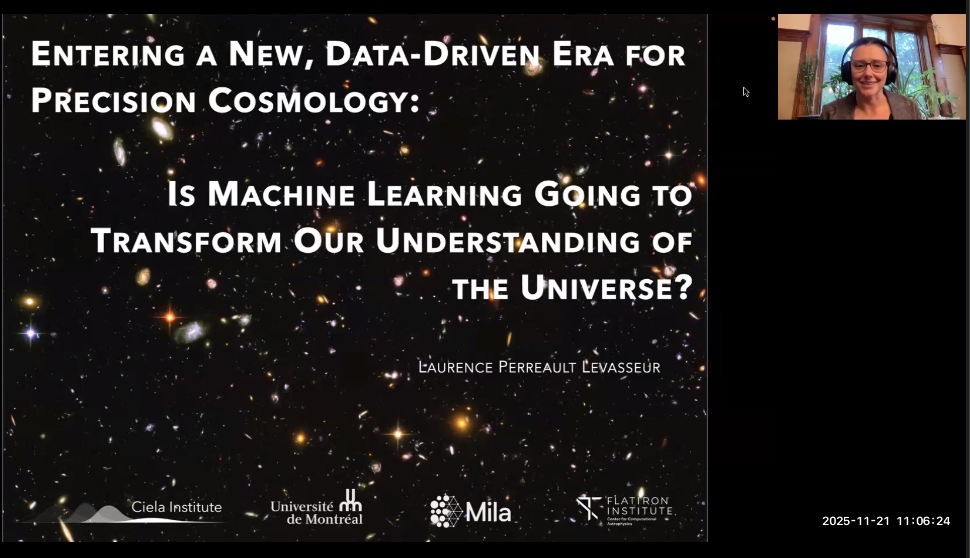
Despite the remarkable success of the standard model of cosmology, the inflationary lambda CDM model, at predicting the observed structure of the universe over many scales, very little is known about the fundamental nature of its principal constituents: the inflationary field(s), dark matter, and dark energy. In this talk, I will give a brief overview of the successes of the inflationary lambda CDM model and discuss how, in the coming years, new surveys and telescopes will provide an opportunity to probe these unknown components. These surveys will produce unprecedented volumes of data, the analysis of which can shed light on the equation of state of dark energy, the particle nature of dark matter, and the nature of the inflaton field. The analysis of this data using traditional methods, however, is entirely impractical. I will share my recent work focused on developing machine learning tools for cosmological data analysis and discuss how these tools can help us overcome some of the most important computational challenges of analyzing data from the next generation of sky surveys.
Bio
Laurence Perreault-Levasseur is an assistant professor at the University of Montréal and an Associate Member of Mila, where she conducts research in the development and application of machine learning methods to cosmology. She is also a Visiting Scholar at the Flatiron Institute in New York City. Prior to that, she was a Flatiron research fellow at the Center for Computational Astrophysics in the Flatiron Institute and a KIPAC postdoctoral fellow at Stanford University. Laurence completed her PhD degree at the University of Cambridge, where she worked on applications of open effective field theory methods to the formalism of inflation. She received her B.Sc. and M.Sc. degrees from McGill University.