
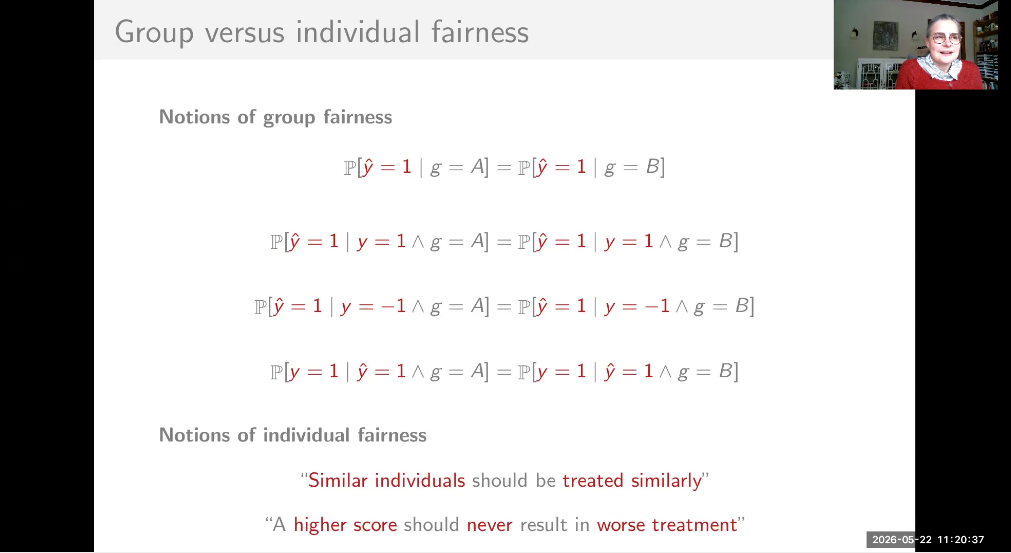
As machine learning has become ubiquitous, resulting automated decision rules are increasingly expected to comply with societal considerations, such as fairness, transparency, and manipulation robustness. In this talk, I will focus on fairness requirements. I will discuss several common objectives that have been proposed in the literature on algorithmic fairness, as well as some common methods to achieve these objectives. The talk is aimed at providing a high-level overview to the topic, and at pointing out some, perhaps unexpected, limitations and pitfalls in this area.
Bio
RuRuth is an Associate Professor at York University in Toronto, Canada. Previous to joining York University, she was a senior research scientist at the Max Planck Institute for intelligent systems in Tübingen, Germany, and a postdoctoral fellow at Carnegie Mellon’s Machine Learning department as well as at Georgia Tech. She received her PhD from the University of Waterloo for a thesis on statistical learning theory in 2013. She regularly serves as a senior program committee member of the major machine learning and learning theory conferences, such as NeurIPS, ICML, ALT and COLT, and serves as the local co-chair for ALT 2026 in Toronto. Her research develops mathematical tools and frameworks for analyzing the possibilities and limitations of machine learning. She is particularly interested in developing formal foundations for aspects of machine learning that relate to evaluation methods and societal impacts, such as human interpretability, uncertainty quantification, robustness and fairness.